Tag Archives: Facebook

Birth of the Social Web: Facebook Connect and Google Friend Connect Now Available to All

December 4, 2008. Today may be remembered as the birth of the Social Web, as two major projects aimed at turning the Web social emerged from their restricted beta periods for general availability, Facebook Connect and Google Friend Connect. Together, these two major events sound the death knell for the walled garden phase of social networking. Early reactions to the news are quick to frame this as a head-to-head battle between Google and Facebook, but the truth requires a look at the details, and I think something much more profound is happening…

First, the similarities. Facebook Connect and Google Friend Connect share the same basic vision of the Social Web. Any site can become social, without having to build up its own social network. Users should be able to access those social features without having to experience the pain of usernames, passwords, uploading a photo, filling out a profile, importing an address book, and re-friending the people they’ve already connected with elsewhere. And, activity streams out to web-wide lifestream aggregators should become important engines of social discovery and growth for the site.

Now to the differences. One major difference between these two offerings is the technology under the hood. Google Friend Connect is built on the “open stack,” leveraging building blocks like OpenID, OAuth, and OpenSocial, whereas Facebook Connect is built on Facebook’s proprietary stack. A second difference is target market. Facebook has clearly focused on major sites, like Digg, Hulu, and CitySearch, and while simple implementations can be done with very little coding, most will involve a bit more complex development. Google, in contrast, has explicitly targeted the “long tail” of the web, sites that would never dream of writing their own social code; the focus of Google Friend Connect is to help these sites become social by cutting-and-pasting a few lines of javascript. The third major difference is one of strategy. Facebook Connect is all about making Facebook more useful to its users all over the Web. Google Friend Connect, on the other hand, is all about making the Web more social, with an approach that incorporates other social networks. For example, the current release integrates not only Orkut, but also Plaxo. (And recall that the earliest version also included Facebook, until Facebook shut that down.)

I’ve been playing around with Facebook Connect and Google Friend Connect all along the way while these services were being carefully tested and refined prior to today’s formal rollout. I like them both, but see lots of room for improvement. But that’s to be expected; this is a major shift in how the Web will work, and there’s a lot of complexity under the covers. Today marks the birth of the Social Web, and we should expect to see lots of rapid progress for this newborn.

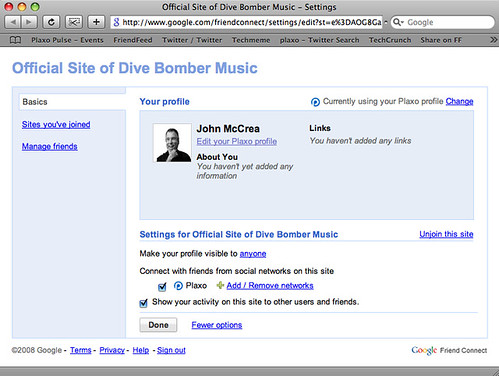
For those who haven’t checked out Google Friend Connect yet, I’m including a few screenshots…

Signing up via Google Friend Connect

Turning on Sharing to Plaxo

Signed in with a single click

Activity shows up in Plaxo!
My activity showing up in Plaxo

Oh, and you can check out the “Dive Bomber” site I used for these screenshots here.

Update: I just realized that I can now declare victory on the prediction I made for 2008, a prediction I made on December 6, 2007!

Update: The new episode of The Social Web TV is now up, with Joseph Smarr and I addressing the question, “Facebook Connect vs. OpenID?”:

Tagged , , , , ,

Facebook, Microsoft and Data Portability

Michael Arrington has a great piece up on TechCrunch entitled “The Very Curious Microsoft-Facebook User Data Relationship“. In it, he shines a spotlight on a most curious thing — that Facebook has given Microsoft access to data on Facebook users that they have said they would not give to anyone, as it would violate users’ privacy. Specifically, he shows screenshots of an import of a Facebook friends list into Microsoft’s IM client, Messenger, in which the user ends up with the email addresses of all of the their friends (and can then connect with them or invite them to Messenger).

As you may recall, this was at the heart of the controversy now know as “Scoblegate,” in which Plaxo had created a Facebook importer that brought a user’s friends list, including email address over into the Plaxo address book. Aside from the interesting questions Michael Arrington raises, I would add this observation: It is great to see this functionality out there, live since March, without a single bit of controversy. That speaks to the utility of data portability. If social networking really is about real people and real relationships, it would be great if sharing information were real sharing of information, not tethered-sharing , which is essentially “social DRM”.

Also, really funny how the official blogpost from Microsoft directly references the Scoblegate incident! That is a head-scratcher!

Updates:

One, I’d love to hear Dare Obasanjo’s perspective on this. A refresher on his position on this issue as of last January.

Two, check out the comment on TechCrunch from Facebook’s privacy officer, Chris Kelly. While he corrects a few things, he does not deny that they are sharing email addresses with Microsoft.

Tagged , , , , , ,

Harnessing the “People Power” of Social Media

On this week’s show, Joseph Smarr and I discuss the significance of how Obama’s team harnessed the “people power” of social media. The stuff we’re all working on to open up the Social Web is not just about socializing, but is also about fundamental changes in society that social media can facilitate.

The episode is also up over at The Social Web TV.

Tagged , , , , , , , ,

Live-Blogging Joseph Smarr’s Talk at the Widget Summit

WidgetSummit08 Cover Slide

I’m up in San Francisco for the Widget Summit, live-blogging a talk by Plaxo’s Joseph Smarr, entitled “The Widgets Shall Inherit the Web.” You can download the Powerpoint here. (Joseph will also upload to SlideShare later.) Talk is starting now..

“There’s a fundamental transition going on, as fundamental as the birth of the Web. The Web is going social, and the Social Web is going open.”

Widget authors: you’re ahead of your time! Widgets thrive in an environment with users, data, social graph, and activity. But, widget have had to live where the data is, inside existing social networks. But soon, the data will come to you, thanks to the “Open Stack”. Widgets are about to be turbocharged “by several orders of magnitude”

Lots of social sites.

Lots of open “building blocks” (OpenID, OpenSocial, OAuth…)

How do the pieces fit together? And what will the Social Web look like?

The social web is broken today. On each site, we have to do the same dance. Create account, enter profile data, upload photo, etc. Currently, social apps have limited options.

New building blocks establish who I am, who I know, and what’s going on

Joseph Smarr at Widget Summit

Who I am. Create a portable, durable online identity. Key technology: OpenID. Key standard gaining real traction and momentum. Showing the Plaxo sign-up page with support for OpenID, including special support for Yahoo OpenID and Google OpenID. Showing JanRain’s MyOpenID with pre-fill of info during onboarding. Faster registration, fewer lost passwords. Good for Plaxo, good for user, and good for Identity Provider. Joseph listing off the major providers: Yahoo, Microsoft, Google, AOL, and (soon) MySpace. “Now is the time to get on board.” “Registration flows historically have high dropoff rates.

Joseph now talking about rel=me (XFN) microformat…

Showing “me on the web,” the trace of publicly-asserted linkages between his blog, and his profile on lots of different services, traced via Google’s social graph API. Showing how is Plaxo you can use that data to lower the friction for letting a user declare the sites they use so they can easily set up feeds. And the loop continues; Plaxo public profile pages can include “you on the web” and it’s marked up in microformats, consumable on other websites.

Now showing the same stuff for a personal blog. Example is David Recordon of SixApart.

Who I know

Tap into the real relationships via Contact APIs from existing address books, typically webmail. Scraping has been the norm, but clearly not good from a security standpoint. Now there are real Contacts APIs from Yahoo, Microsoft, and Google, and that’s great.

Of course, that data is not public, so you need a way to grant access to it securely, which brings us to OAuth. “How do I let users grant access to their data without giving up their passwords to third-parties?” Each of the big players created their own unique, proprietary auth technology, which led to a lot of developer pain. So the big players are now shifting over to OAuth, an open spec approach to the problem. But one-time import is not as good as continuous discovery, which brings us to the concept of friends-list portability.

Showing nice integration between Flickr and Google. “If you haven’t done it, check out import on Flickr. You’ll be surprised.” Now on to Dopplr.

What’s going on

The last piece is the rich context of what the people you know are doing online. Now to OpenSocial, that let’s you build social apps that can run (almost) anywhere. Showing the original integration on Plaxo. “What’s really cool is the sharing of the activity stream into the feed.” “OpenSocial has gone mainstream, big time.” Showing graph of number of users (reaching to something like 500 million, I think.)

Now RSS/Atom. “Syndicate your activity”. Giving example of recent Netflix API which has Atom feeds of Netflix ratings, protected behind OAuth, which Joseph integrated in Plaxo. Now Jabber/XMPP for “real-time update stream between sites”. Example: Twitter integration in Plaxo.

“If you’re a big site, folks might do a custom integration, but if you’re a small site, be on the lookout for open standards that you can draft off of.”

Joseph Smarr at Widget Summit

Now, to pull it all together.

The user is at the center. Then all around, socially-aware sites of the Web. In the middle? A new services layer, with Identity Providers; Social Graph Providers; and Content Aggregators. (My editorial add: Some companies may focus on one or two of the layers, but the brass ring is the triple play.) Joseph now saying his version of that, and pointing out what Facebook, Yahoo, and others are up.

Now, a day in the life of the Social Web

Using me as an example, checking out a microbrew enthusiast site. I use my OpenID to onboard. I write a review, and it flows to my aggregator of choice. Joseph discovers it and joins the site to. All part of a “virtuous cycle.” This is just like the virtuous cycle that gave birth to the Web. More sites lead to more people downloading a browser, which leads to more people making websites. Repeat. It’s the same now, but to make it happen, the data must be able to flow. “Open” is the breakthrough.

Returning to “Who I know”…

“Something I glossed over.” How does friends-list portability actually work? Discovery via XRDS-Simple.

As with auth, all the big guys came up with their own Contacts APIs. Now, we’re moving to Portable Contacts. More info here.

“What’s cool is that we worked with the OpenSocial community to align Portable Contacts with the OpenSocial RESTful APIs, so you’ll get support for Portable Contacts for free from any site that is OpenSocial RESTful APIs.”

There’s now a clear vision, shared by Facebook Connect, MySpace Data Availability, Yahoo Y!OS, Google Friend Connect, and Plaxo Pulse: Identity Providers; Social Graph Providers; Content Aggregators.

“What’s even cooler? Almost everyone is building on the new Open Stack. And it’s not hard to imagine Facebook joining this movement, too.”

MostBuildingOnOpenStack

Tagged , , , , , , , , , , ,

Announcing Episode 15: “On Location at Yahoo!”

We’ve just posted this week’s episode of The Social Web TV, “On location at Yahoo!” I chat with special guest, Allen Tom, Architect, Yahoo! Membership, about last week’s Y!OS rollout and this week’s historic OpenID/OAuth UX Summit.

And, in case you missed it, I did a guest post on the topic at TechCrunchIT, entitled, Facebook Connect and OpenID Relationship Status: “It’s Complicated”.

Oh, and Dare Obasanjo wrote a response to my post, entitled Some Thoughts on OpenID vs. Facebook Connect

Tagged , , , , , , , ,

Live Blogging the OpenID/OAuth UX Summit

From the OpenID/OAuth UX Summit

I’m at Yahoo for the OpenID/OAuth UX Summit. The room is packed with 40 or so folks. Companies with representation include Yahoo, Google, Microsoft, Facebook, MySpace, Plaxo, AOL, SixApart, JanRain, Vidoop, Chi.mp, and Magnolia, and projects including Internet2 and DiSo. The Summit is a response to recent usability studies by Yahoo and Google that show the current state-of-affairs with OpenID and OAuth is quite poor, and we need together to find a user experience for the “open stack” that works for consumers.

I’ll be sharing observations over the course of the day.

First up: Facebook’s Julie Zhuo, sharing experience from Facebook Connect. Idea originated in 2006 with the Facebook API. Initial version didn’t have any flow back to Facebook. Clunkiness of UI. One question for the Facebook Connect UI: How much text is really needed? Showing evolution of the UI to address the fundamental question, “What is Facebook Connect?” Final version includes user’s profile photo (if user is logged in), and thumbnails for both Facebook and the site user wants to connect.

From the OpenID/OAuth UX Summit

Good discussion about what usability revealed, about informed consent and user confusion, and about whether this passes EU privacy laws. (Answer: yes.) Facebook research showed that users had little or no understanding or savvy about phishing and URLs.

By the way, I have to say it — great to see not only is Facebook attending this “open stack” summit, but that they’ve got four people here (including Dave Morin, Josh Elman, and Mike Vernal) and leading the opening session! That’s awesome.

From the OpenID/OAuth UX Summit

Now talking about the Connect Button. First version had tagline “Bring your friends,” but users didn’t know it was a button. Second version said “Register.” Third version said “Connect” and experimented with the user’s profile photo on the button. Final version is just the Facebook “f” and “Connect” or “Connect with Facebook”.

Discussing logout options: unified, per-site, hybrid. Unified is secure, but unintuitive. Per-site is intuitive, but not necessarily secure. Chose unified out of security. Question for the future, if Facebook Connect takes off, may be strange to log out from one site and be instantly logged out of Facebook and all other Connect sites. A good laugh, as Joseph Smarr suggests a slightly more complex alternative. Julie says, “But then you’d make the user have to think.” Joseph’s aside, “That’s spoken like a true mainstream consumer site.” Incredibly active session. Key takeways slide: streamlined login is important. Explain what is going on. Err on the side of security. Flexibility is important.

Next up: Max Engel of MySpace. “The Hybrid Login: OpenID and OAuth.” MySpace will support OpenID, OAuth, and a hybrid of the two. Will use a pop-up iframe. Allows the user to stay in context. Max is showing screens of the experience they are planning. Every MySpace user has a vanity URL, which will be their OpenID. Still trying to figure out whether to support logging with just “MySpace.com”. Key design elements will be similar to Facebook Connect.

Data types: content, address book, registration, profile, friends, activity. Big laugh as Max shows the original OAuth screen, that has so much fine print that it looks like it was designed by a lawyer! Lots of discussion about whether email address should be passed to the site. Why it matters: not just for communicating, but also to avoid duplicate account problem Plaxo has experienced as an OpenID Relying Party and Yahoo OpenID. Chris Messina advancing the idea of email address as OpenID, something under consideration for OpenID 2.1.

Max revisiting that MySpace Data Availability originally was to have zero cacheability of the data, which was not going to fly with anyone. Now planning a “portable profile” plus some cacheable MySpace-specific data. Allen Tom of Yahoo raises the point that the “cacheable” data is all on public pages already, so why not just mark it up with microformats and remove the caching restriction. “If Relying Parties don’t get the data they need, OpenID only creates complexity.” Max just mentioned Portable Contacts in his presentation. Drink!

So many tough questions about complexity and confusion vs. simplicity but lack of clear, informed consent. Good discussion about whether participating sites can use the profile data they pull in to do targeting (including ad targeting). Facebook team says that they allow the site to use the data for targeting on the site, but not to redistribute the data (to an ad network, for example). Makes sense.

Max says that the sell to major websites is much stronger for combination of OpenID, OAuth, XRDS-Simple, Portable Contacts, and OpenSocial. Question from the back of the room, “What do you call all of that?” Answer popping up from Max, Joseph, Chris Messina, and me, “The ‘Open Stack’!”

Rising chorus for coming together to develop a common UI spec for OpenID. A call for five volunteers. Hands raised include Chris Messina (Vidoop), Joseph Smarr (Plaxo), Eric Sachs (Google), Max Engel (MySpace), and, drumroll, Julie Zhuo (Facebook). That’s great!

LUNCH BREAK

Next up: Allen Tom of Yahoo. Over 300 million users have an OpenID from Yahoo. Question shouted, “How many have used it?” Answer: “It has exceeded our expectations.” 😉 But, yes, we’re all here because we know we need to improve the user exerience.

Launched BBAuth in 2006. Showing “Find Friends” on Facebook and LinkedIn, using BBAuth. BBAuth and OAuth is to grant long-lived credentials to third-party sites. “Cannot allow weaker credentials to be used to mint stronger credentials.” Talking about various security considerations. Login screen must never be framed. Anti-phishing sign-in seal must always be displayed.

Allen now showing the “scary screen” which users are shown to approve access via BBAuth. *Lots* of small print legaleze. “Based on the feedback on BBAuth, we changed our approach on OAuth, which is what we’ll be using going forward.” Now, been spending a lot of time looking at and talking through the OAuth permissions screen.

Allen now showing and talking about Yahoo’s implementation of OpenID. It is *much* improved over the version they went out the door with (shrinking 14 steps to two). Allen shares that “machine-generated” OpenID URLs have proven *way* more popular than user-selected. Surprised reactions.

Talking now about Plaxo’s experience as an OpenID Relying Party. The business rationale, the philosophical view, and the admission that OpenID experience is not yet today a clear net positive to the key metrics. But Plaxo remains optimistic that the situation can improve dramatically with what’s being discussed here today.

Next up, Magnolia’s Larry Halfft. They’ve used OpenID as a key part of their strategy to reduce spam accounts and have been generally pleased with the results.

Now, Eric Sachs of Google, who just showed what I think is the first public demo of Google as an OpenID Provider. Giving context: SaaS vendors get asked to be a SAML RP for enterprise IDPs. In parallel, Google Checkout folks had questions/issues with login. Giving examples of login on Buy.com and Amazon.com, as an inspiration for a new/better? login experience for OpenID/OAuth. Now the challenge of desktop apps and OAuth. Seems like “No, help me sign in” is the key verbiage of this new “LSO” login model Eric is advocating. Now Google Accounts vs. accounts for Google AppsForYourDomain. Downside to this LSO login approach is that it does not work well for IDPs who are not email providers.

Lots of good-natured joking as we try to do a demo, that requires a Windows computer with .Net and IE as the default browser. Not easy to find in this crowd!

It’s 3:00pm. We’ve now finished the formal agenda and are discussing how folks would like to organize the last two hours.

It’s almost 4:00pm. Joseph Smarr of Plaxo is demoing the “Open Stack” end-to-end stuff that was developed by JanRain for the Portable Contacts Summit. OpenID, OAuth, XRDS-Simple, and Portable Contacts working together to enable simple and secure sign-up with access to user’s profile and address book. Good discussion underway. Joseph now explaining XRDS-Simple and answering a lot of questions.

Joseph Smarr demoing the "Open Stack"

Chris Messina now leading a discussion about the proposal to extend the OpenID spec to allow email addresses as OpenIDs. Mike Jones of Microsoft asserts this creates a major security vulnerability. Discussion underway.

Some discussion of how to handle if the Provider site is down. Mike Vernal of Facebook responding to that question vis-a-vis Facebook Connect. Good response.

5:15. That’s a wrap. What a great day. The UX working group got a bit larger at the end, which is good. Eager to see what they come up with!

Tagged , , , , , , ,

Joseph Smarr at Web 2.0 on the New “Open Stack”

Joseph Smarr, Plaxo’s chief platform architect, and de facto leader of the Portable Contacts initiative, gave a talk today at the Web 2.0 conference in New York. Entitled “Tying it all together; Implementing the Open Web,” it was a rallying cry for developers to jump in and get working on the new “open stack” of OpenID, OAuth, OpenSocial, XRDS-Simple, and Portable Contacts. See converage from attendees Kris Jordan and Steve Kuhn (who quips about Joseph, “Dude talks fast”)!

Joseph asserted that the industry has now come together around a common vision for the future of the Social Web — a vision that abandons the walled garden model in favor of a new services layer that interconnects social hubs with the rest of the web. The service layer is comprised of Identity Providers, Social Graph Providers, and Content Aggregators:

A Common Vision for the Future of the Social Web

And, indeed, that is the vision behind the strategies we see from Google (with Friend Connect; which launched for real today), Plaxo (with Pulse), MySpace (with Data Availability), Yahoo (with Y!OS), and, yes, even Facebook, too (with Connect).

Joseph goes on to observe that there are two pathways to that vision, one built on Facebook’s proprietary stack and the pathway chosen by MySpace, Google, Yahoo, Plaxo, and many others, built on the new open stack:

The New "Open Stack" for the Social Web

Tagged , , , , , , , , , , ,

Live Blogging from the Portable Contacts Summit

The much-anticipated Portable Contacts Summit has kicked off, with folks from companies large and small and representatives of various open-spec communities. Joseph Smarr of Plaxo is leading the opening session and is going through a bunch of demos of working code.

Some quotes:

“The Portable Contacts train has left the station, and it’s a bullet train.”

“I’ve got more demos than I have Firefox tabs.”

“One good pipe deserves another.”

Joseph is demoing the power of having technical alignment between Portable Contacts and OpenSocial RESTFul APIs. What that means is that any site that is OpenSocial compliant will be Portable Contacts compliant — without having to do any additional work!

Folks in attendance include people who work at Google, Microsoft, Yahoo!, MySpace, Facebook, Hi5, Plaxo, Six Apart, Seesmic, JanRain, Skydeck, ShopIt, Current.TV, Interscope Records, and more. Today’s event is hosted by MySpace.

12:00 Joseph demoing interop between Plaxo and MySpace.
12:05 Now a demo of JanRain’s myOpenID with support for Portable Contacts
12:07 Now on to Google, another instance of compliance via OpenSocial RESTful APIs
12:08 iGoogle, GMail, and Orkut (all leveraging the same backend)
12:09 Brian Ellin of JanRain about to do a demo of an end-user application
12:11 Brain implemented Portable Contacts last night in Ruby

lunch break

1:00 About to resume. Saw amazing discussions over lunch. I won’t name names, but some would be shocked by the various pairings of competitors breaking bread together
1:15 Joseph leading a deep dive on the spec. Lots of questions, discussion.
1:30 Lots of great questions and discussion about OAuth and XRDS-Simple
3:00 Wow! Just barely made it all the way through the spec. Impressive. Everyone is fried.
3:30 Unconference phase now, but really informal; organically forming conversation circles.
4:15 About to do the next steps and wrap up

Kevin Marks, of Google, is doing a nice job live tweeting the event. He’s @kevinmarks on Twitter.

UPDATE:

Great posts from the team at ShopIt and from data portability maven Daniela Barbosa.

And another fine post from the godfather of open, Marc Canter.

Here are a few photos so far:

Spec-compliant name tag

Joseph Smarr kicks off the Summit

Around the room

Brian from JanRain

Brian of JanRain and Joseph of Plaxo

Portable Contacts deep dive

Tagged , , , , , , ,

The Rapid Rise of FriendFeed and Plaxo’s Pulse

There is a sea change underway in social networking. If there were any doubt that we are moving from the “walled garden” phase to a new era defined by interoperability between aggregation hubs and the rest of the Social Web, recent moves by Facebook and MySpace should erase any doubt.

The biggest winners of the future will be the services that do the best job of harnessing the power of the virtuous cycle of social discovery at the core of “Social Web Aggregation.” Let’s take a look at how two pioneers of the new model are faring, Plaxo Pulse and FriendFeed…

Before looking at the numbers, it’s important to remind ourselves that last summer, walled gardens were the future. Plaxo wasn’t yet in the social networking space. And FriendFeed hadn’t yet launched their service. It was almost exactly a year ago that Plaxo launched Pulse, the first Social Web Aggregator. [Disclosure/reminder: I work for Plaxo, but you already knew that.] One of the key questions was, “Are enough people using multiple user-generated content sites that one can build a thriving service based on ‘lifestreaming’ the activity streams from those services?”

So, let’s look at the July numbers from Compete, which just became available within the last 48 hours. [One caveat, every third party traffic tracking service has it’s limitations; Compete is looking just at U.S. traffic and does not have visibility to activity originating from client software.] How are the two most prominent pure-play Social Web Aggregators faring? In a word, “thriving.”

Plaxo and FriendFeed both posted greater that 20% month-over-month growth from June to July, and Plaxo clocked 225% year-over-year growth in monthly unique visitors. (Year-over-year data for FriendFeed not yet available, but coming soon.) The slope of Plaxo’s rise is slightly higher than FriendFeed’s, but that is not as significant as the clear sign that both services are surging.

I am an enthusiastic user of both services and I don’t see them as competing with each other. Quite the contrary. I love using FriendFeed for staying on top of what the early adopter and influencer crowd are buzzing about in public conversations. And I love using Plaxo for private sharing and conversing with highly granular control of what I share with whom.

As a footnote, the rising “aggregation” tide is *not* floating all boats equally. Latecomers, with little obvious differentiation, such as Iminta and SocialThing, have generated so little traction as to barely show up in Compete.

Congratulations to Plaxo (who pulled off a re-invention of the company and has managed to execute well through a change of ownership) and to FriendFeed (who have entered a hot space with really great focus and execution). Game on!

Tagged , , , , ,

An Historic Week for the Social Web

Episode 3, Live from F8

Wow, what an historic week for the opening up of the Social Web! MySpace confirmed that they will become an implementer of OpenID. Facebook shared their passion for bring social to all of the Web, and shared some details on Facebook Connect at the second annual F8 developer conference. And up at OSCON, David Recordon announced the formation of the Open Web Foundation.

David, Joseph Smarr, and I share our perspective in the highest energy episode so far of our Internet show, The Social Web TV.

Tagged , , , , , ,