
I’m up in San Francisco for the Widget Summit, live-blogging a talk by Plaxo’s Joseph Smarr, entitled “The Widgets Shall Inherit the Web.” You can download the Powerpoint here. (Joseph will also upload to SlideShare later.) Talk is starting now..
“There’s a fundamental transition going on, as fundamental as the birth of the Web. The Web is going social, and the Social Web is going open.”
Widget authors: you’re ahead of your time! Widgets thrive in an environment with users, data, social graph, and activity. But, widget have had to live where the data is, inside existing social networks. But soon, the data will come to you, thanks to the “Open Stack”. Widgets are about to be turbocharged “by several orders of magnitude”
Lots of social sites.
Lots of open “building blocks” (OpenID, OpenSocial, OAuth…)
How do the pieces fit together? And what will the Social Web look like?
The social web is broken today. On each site, we have to do the same dance. Create account, enter profile data, upload photo, etc. Currently, social apps have limited options.
New building blocks establish who I am, who I know, and what’s going on

Who I am. Create a portable, durable online identity. Key technology: OpenID. Key standard gaining real traction and momentum. Showing the Plaxo sign-up page with support for OpenID, including special support for Yahoo OpenID and Google OpenID. Showing JanRain’s MyOpenID with pre-fill of info during onboarding. Faster registration, fewer lost passwords. Good for Plaxo, good for user, and good for Identity Provider. Joseph listing off the major providers: Yahoo, Microsoft, Google, AOL, and (soon) MySpace. “Now is the time to get on board.” “Registration flows historically have high dropoff rates.
Joseph now talking about rel=me (XFN) microformat…
Showing “me on the web,” the trace of publicly-asserted linkages between his blog, and his profile on lots of different services, traced via Google’s social graph API. Showing how is Plaxo you can use that data to lower the friction for letting a user declare the sites they use so they can easily set up feeds. And the loop continues; Plaxo public profile pages can include “you on the web” and it’s marked up in microformats, consumable on other websites.
Now showing the same stuff for a personal blog. Example is David Recordon of SixApart.
Who I know
Tap into the real relationships via Contact APIs from existing address books, typically webmail. Scraping has been the norm, but clearly not good from a security standpoint. Now there are real Contacts APIs from Yahoo, Microsoft, and Google, and that’s great.
Of course, that data is not public, so you need a way to grant access to it securely, which brings us to OAuth. “How do I let users grant access to their data without giving up their passwords to third-parties?” Each of the big players created their own unique, proprietary auth technology, which led to a lot of developer pain. So the big players are now shifting over to OAuth, an open spec approach to the problem. But one-time import is not as good as continuous discovery, which brings us to the concept of friends-list portability.
Showing nice integration between Flickr and Google. “If you haven’t done it, check out import on Flickr. You’ll be surprised.” Now on to Dopplr.
What’s going on
The last piece is the rich context of what the people you know are doing online. Now to OpenSocial, that let’s you build social apps that can run (almost) anywhere. Showing the original integration on Plaxo. “What’s really cool is the sharing of the activity stream into the feed.” “OpenSocial has gone mainstream, big time.” Showing graph of number of users (reaching to something like 500 million, I think.)
Now RSS/Atom. “Syndicate your activity”. Giving example of recent Netflix API which has Atom feeds of Netflix ratings, protected behind OAuth, which Joseph integrated in Plaxo. Now Jabber/XMPP for “real-time update stream between sites”. Example: Twitter integration in Plaxo.
“If you’re a big site, folks might do a custom integration, but if you’re a small site, be on the lookout for open standards that you can draft off of.”

Now, to pull it all together.
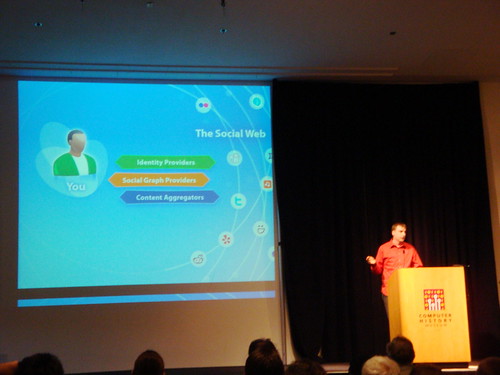
The user is at the center. Then all around, socially-aware sites of the Web. In the middle? A new services layer, with Identity Providers; Social Graph Providers; and Content Aggregators. (My editorial add: Some companies may focus on one or two of the layers, but the brass ring is the triple play.) Joseph now saying his version of that, and pointing out what Facebook, Yahoo, and others are up.
Now, a day in the life of the Social Web
Using me as an example, checking out a microbrew enthusiast site. I use my OpenID to onboard. I write a review, and it flows to my aggregator of choice. Joseph discovers it and joins the site to. All part of a “virtuous cycle.” This is just like the virtuous cycle that gave birth to the Web. More sites lead to more people downloading a browser, which leads to more people making websites. Repeat. It’s the same now, but to make it happen, the data must be able to flow. “Open” is the breakthrough.
Returning to “Who I know”…
“Something I glossed over.” How does friends-list portability actually work? Discovery via XRDS-Simple.
As with auth, all the big guys came up with their own Contacts APIs. Now, we’re moving to Portable Contacts. More info here.
“What’s cool is that we worked with the OpenSocial community to align Portable Contacts with the OpenSocial RESTful APIs, so you’ll get support for Portable Contacts for free from any site that is OpenSocial RESTful APIs.”
There’s now a clear vision, shared by Facebook Connect, MySpace Data Availability, Yahoo Y!OS, Google Friend Connect, and Plaxo Pulse: Identity Providers; Social Graph Providers; Content Aggregators.
“What’s even cooler? Almost everyone is building on the new Open Stack. And it’s not hard to imagine Facebook joining this movement, too.”




 The Real McCrea