The Web Social: Alpha at Fluid

Just got home from the Alpha cocktail party at Fluid. A real who’s who of Web 2.0. Joseph Smarr (also of Plaxo) and I had many great conversations. Got to mix it up with Michael Arrington of TechCrunch, Karl Jacob of Wallop, Brian Solis of FutureWorks, Megan McCarthy of Valleywag, Scott Rafer of Lookery, Jay Adelson of Digg, Shel Israel of Naked Conversations, and many more (no slight meant, if I failed to mention you!). Took a few pictures, too…

Kraftwerk? Nein.

The Bar

Joseph Smarr at the Bar

Megan from Valleywag

Mysterious Ladies in Black Dresses

“Social Search” Rocks!

Wow. Ever since Plaxo launched Pulse, I’ve been among the many voices asking for the addition of search, because I always thought it would help harness the “wisdom of my own crowd.” But now that it’s here, I think the implications are far bigger.

In fact, I think Robert Scoble is right about the long-term implications of applying who-you-know to the problem of search. I now have over 1,000 pages of content in my river of lifestreams on Pulse.  So, I can type in “sushi,” and find several restaurant reviews on Yelp from people I know and respect. I can search on the keyword “Facebook,” or “walled garden” and see all the blogposts, Twitter tweets, and Diggs on those topics from people in my address book.

And more, I can do the social equivalent of “googling” people I know. Names like “Scoble” and “Arrington” bring up a ton of references from the journalists and A-list bloggers I’m connected to. Putting in “McCrea” yields fewer hits, but they include a blogpost from Robert Scoble and a Twitter tweet from South African Web 2.0 thought leader, Paul Jacobson. What are people in the open social web saying about you? Check your Pulse.

Plaxo Pulse now Has Search!

Okay. I swear I didn’t know the Pulse team was going to add Search this week when I wrote my last post! I guess while I was on vacation, someone got really motivated and just wrote it. So, now you can search across all the events and comments in your stream of feeds. Way cool!

Plaxo: My “Pulse” is Racing

Just getting back into the deep end of the infopool after returning last night from a short vacation  in Kauai. Noticed a major milestone in my use of social networking while I was enjoying a little tropical paradise. My stream of feeds in Plaxo Pulse topped 1,000 pages! (Now, I sure hope the team adds Search sometime soon, so I can mine this growing body of content.)

I also am pleased to report that Pulse usage is really starting to spread in my family. So much so that I have now changed the sharing settings on my photo feed in Pulse to be just for family and friends. (That way I can also spare my business network from seeing a ton of my vacation photos.)

Ice Cold Coconut!

Alas, now I guess I have to go wade through my Outlook stream…

Why Plaxo Does Not (Yet) Have a Facebook App

Well, I’m on vacation this week on the beautiful island of Kauai, but I am trying to keep up with the exciting stuff going on in the social web space.

Congratulations to the Jaiku team, for landing at Google. Given the “open” moves Google is rumored to be making, that should be a fun ride for folks.

Saw this video interview with Plaxo’s Joseph Smarr about why Plaxo is not just following the herd and banging out one or more Facebook apps. Joseph can always be counted on to be articulate and passionate, and he doesn’t disappoint here.

Really wishing that Dave McClure’s conference, Graphing Social Patterns, didn’t overlap my vacation! Eager to hear how things went there! Now, time for another Mai Tai…

Picture 017

Plaxo and Facebook: Time to Sing Kumbaya?

IMGP2690

Can it be? Is it time to hold hands and sing songs of unity and closeness?

Google is reported to be ready to join the open social web movement. Rumors are swirling that Facebook may about to make a move in that direction, too. Mark Zuckerberg has friended Plaxo’s Joseph Smarr, co-author of the Bill of Rights for Users of the Social Web. And now Plaxo, today, added Facebook to its lineup of feeds in Pulse, alongside MySpace, Flickr, Twitter, Yelp, Pownce, Jaiku, and 20 other user generated content sites!

Alas, though, this is but a baby step. Plaxo is just taking existing RSS feeds of your “Notes” and your “Posted Items” and flowing them into Pulse. Your virtual address book on Facebook remains out of reach, behind the wall. But, if the rumors I’m hearing are true, the walls just might be crumbling a bit…

Your Friends List: Address Book 2.0

Address books have always evolved with the pace of information technology. But whether we’re talking about a “little black book,” a Rolodex, or Plaxo and other Internet-based “networked address books,” the core concept has generally been the same. An address book is a list of the people you know, along with whatever contact information you have for them (no matter whether you stapled some business cards to your Rolodex, typed the info in by hand to a spreadsheet or database, or got some of it through permission-based sharing in a network).

There’s one other important commonality: who owns the data. Whether it’s stored as ink on paper, bits on a single hard drive, or distributed “in the cloud,” each address book is owned by the person who assembled it. And the owner of the address book can choose to copy it, delete it, or modify it. Indeed, they can, with the right supporting technology, sync it to a variety of tools and services.

Enter social networks and the notion of a “friends list.” Now, if friends lists were just meaningless, loose, and largely anonymous linkages, as seen in MySpace and other early social networking sites, I wouldn’t be writing this post.

But with the rise of Facebook, LinkedIn, and other social networks that are grounded in the real world “social graph,” we see the emergence of a new form of address book. It’s still a list of who you know, and some contact info, but now we have the really dangerous situation of “walled garden” companies claiming that they — not you — own this latest incarnation of your address book.
FacebookAddressBook

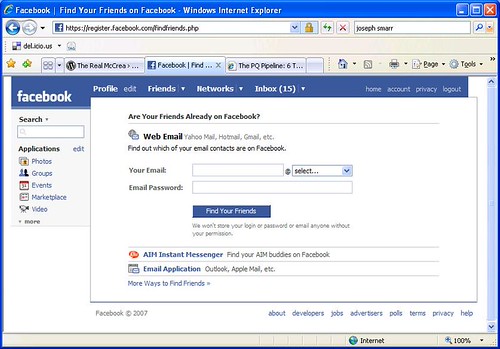
For example, in Facebook, you can upload all your address books (from Gmail, Yahoo! and more) and stitch up a bunch of connections from those contacts, but don’t try to export that address book you’ve built up there. Don’t dare to sync it with Outlook or your Mac address book. And for that matter, don’t even think of trying to do it manually, by cutting and pasting the e-mail addresses, one-by-one, from the list of people you know. Why? Because the e-mail addresses are rendered as images, not text. Access denied. Your address book has now become the captive of a corporation.

IMG_1035

I am confident that this is an untenable strategy for Facebook. It may take a while for people to realize what is being taken away from them, but they eventually will. How long do you think it will take?

If you agree with me, you might be interested in the draft of the Bill of Rights for Users of the Social Web, co-authored by Joseph Smarr, Marc Canter, Robert Scoble, and Michael Arrington.

Friendfeed Says, “Me, too.”

In one of the strangest product launches I’ve seen in a while, four ex-Googlers yesterday went out with a private beta of “Friendfeed,” an apparent direct clone of Plaxo Pulse! (Disclosure: Yes, I head up marketing for Plaxo, so am clearly a biased source on this story.)

Michael Arrington featured the announcement on TechCrunch. I, and many others, were quick to point out in the comments the remarkable similarity between their screenshot and our shipping product.  For this marketer, the unanswered question is, “What were they thinking?” Surely, they had to expect that people would notice.

Not sure what their differentiation strategy will be in the long run, but it is nonetheless good to see more offerings that seek to harness the power of the open social web.

Okay. Let’s Party Like It’s 1994. Yes, 1994.

As many of you who know me have heard, I am conducting an informal survey. “What year in the 1990’s is this year most like?” It’s a question that probes deeply one’s thoughts about Silicon Valley business cycles and where we are with respect to riding those Maverick waves that don’t come every day, month, or year.

I’ll do a more detailed post soon, but you heard it here first — I believe it’s 1994. Why? Because the social web is not just “fun,” it’s “fundamental.” Social graphs turbo charge apps. Stay tuned.

In the meantime, here are my photos from this evening’s SF Beta event…

IMG_1505

IMG_1509

IMG_1524