Facebook Snubs Data Sharing Summit

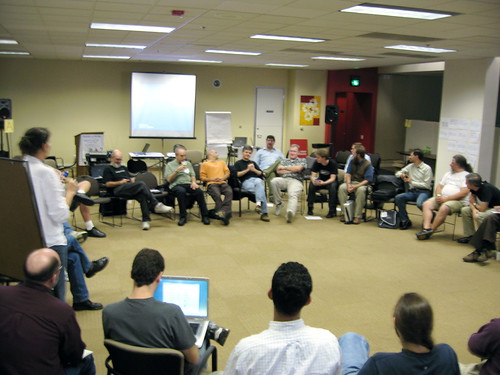
Marc Canter‘s Data Sharing Summit has concluded, and it was a very important gathering. By all accounts, it exceeded the expectations of the 70 or so attendees.

Kaliya did a great job facilitating, using the open space model of unconferences to allow natural order to emerge from the potential chaos. And that’s not easy, given the political and technical hurdles to enabling the sharing of users’ personal information between various commercial services in a manner that keeps the user fully in control.

What impressed me most? All of the “big guys” took the event seriously, and made sure to have action-oriented representatives there. The various discussions were greatly enriched by having heavy-hitters from Google, Yahoo, Microsoft, and AOL present and engaged. And, without exception, these titans of the online world were strongly supportive of the core notions embodied in the Bill of Rights for users of the social web.

What was the biggest disappointment? Facebook did not view the topic of interoperability between social networks to be important enough to even send a representative. To make matters worse, they had said they would, so over the course of two days, we kept thinking Facebook would show up at any minute to enliven the debate. Of course, I should have known better. Facebook backed out of the Office 2.0 panel, cancelled Wednesday’s planned meeting with Marc Canter and Joseph Smarr of Plaxo to discuss the Bill of Rights, and avoided the Bar Camp Block in Palo Alto a few weeks ago. Apparently, their version of “open” does not inlcude direct engagement with other participants in the industry and the community.

On a positive note, we had a great discussion about the Bill of Rights (draft 1.0) and how to refine it to make it something that the “big guys” can easily get through their legal departments. Details aside, what was clear is this: Google, Yahoo, Microsoft, and AOL are all on the right side of the debate, along with Plaxo, and a number of the up-and-comers, like Marc’s Broadband Mechanics. So, even if one or two of the “walled gardens” choose to opt out of the Open Social Web, that will be their business decision, and one that lodges them squarely on the side that loses in the long run — the “closed network” proponents.

As the summit came to a close, many participants stepped foreward to plant their signature on the poster-sized version of the Bill of Rights. Now, I need to bring it to the co-authors who haven’t had a chance to sign, including Robert Scoble and Michael Arrington. And then, I plan to bring it over to Facebook, to see if any of their employees support the notion that users should have ownership, control, and portability of their personal information…

Here are some of my pictures from the event:

IMG_0921

IMG_0925

IMG_0930

IMG_0933

IMG_0936

IMG_0937

IMG_0949

Stumping for the Bill of Rights

It was a good day for the Bill of Rights for users of the social web. I featured it prominently in my talk on the “Social Computing” panel, representing Plaxo at Office 2.0, and a bunch of positive comments came to the opensocialweb.org website. What inspired me the most? So many of the comments were of the form, “We’ve translated the Bill of Rights into (our language, including Spanish, French, Polish…).”

 What’s next? I got the Bill of Rights turned into a big poster. It’s in my car right now, and I’ll be bringing it with me to the Data Sharing Summit tomorrow morning, so everyone their can put their “John Hancock” on it!

Oh, and here’s just a couple pics from today at the Office 2.0 conference. Looked like CNET’s Rafe Needleman was *all over* the event…

IMG_0918

IMG_0920

Office 2.0: Wine on the Roof

Went up to SF this evening for the registration party for Office 2.0, which followed an unconference to warm things up today. Ran into Robert Scoble, Dan Farber, Jeremiah Owyang, Kaliya (Identity Woman), and Ross Mayfield, among many others. Lots of good converations about what Plaxo is doing to open up the social web. Oh, and the appetizers were very nice, too, especially for this vegetarian. Check out a few pics…

IMG_0886

IMG_0894

IMG_0896

IMG_0905

IMG_0912

Bill of Rights: Will Facebook Sign On?

Last night, Plaxo’s Joseph Smarr published a “Bill of Rights” for users of the social web, which he co-authored with Marc Canter, Robert Scoble, and Michael Arrington.

It will be really interesting to see who embraces this user-centric vision for the future of the social web — and who does not. Will Facebook hear the call and change its ways? And if so, will that happen quickly, or only after a long and painful internal struggle? (Maybe I should put up a poll to see what people think. Gotta figure out a good way to do that.)

I was looking forward to having that discussion on the Social Computing panel at Office 2.0 tomorrow, but Facebook decided not to field a delegate…

Some are questioning whether all this matters, especially if Facebook and others do not jump on board right away. But I don’t see it that way. Joseph is not just another smart guy thinking about the web; he writes code and heads up Plaxo’s platform efforts. He’s recently implemented at Plaxo support for OpenID and microformats, and released to open source a semantically-aware crawler that helps stitch together one’s online identity. The guy is on a mission to open up the social web by making Plaxo the “ultimate mashup.”

So, what should we expect out of all this? First a few companies in addition to Plaxo will embrace the Bill of Rights and implement the four elements of support it outlines. As a result, those sites will be enhanced by user-controlled flow of information between them — and their users will enjoy benefits not previously possible. Then, a few more socially-enabled apps will jump in, hooking up to this emerging “open social web,” and all of the apps will get even better.

We have seen this movie before, in 1994, as the web blossomed, with openness giving rise to a more rapid rate of innovation than is possible inside the walled gardens.

Upcoming: Office 2.0 and the Data Sharing Summit

I’m looking forward to two industry events next week, Office 2.0 and the Data Sharing Summit. Drop me a line if you want to meet up at either of them…

Office 2.0

The conference is September 5-7 in San Francisco. And everyone going gets the choice of a free iPhone or a free Playstation 3! I’ll be on a “Social Computing” panel Thursday, September 6 at 1:20pm, moderated by Shel Israel, co-author of Naked Conversations. Others on the panel include Gina Bianchini of Ning, Adam Nash of LinkedIn, and Shiv Singh of Avenue A|Razorfish.

Data Sharing Summit

This new event, Marc Canter’s brainchild, is September 7 and 8 in Richmond, CA. Plaxo is a sponsor, and I’ll be doing my best to represent the company there (as Joseph Smarr, our ideal representative, will be on vacation at that time).

Scoble and the Open Social Web

There are a lot of folks covering the social web space, but Robert Scoble is unique in how deeply he embraces the new technologies and makes them integral to his life and his profession. It was an honor to host his visit today to Plaxo HQ and to share with him details of what we’re announcing tomorrow, an Online Identity Consolidator, that is a key weapon in the defense of the open social web. Check out the video interview with me and Joseph Smarr. Lots of good discussion about how this all relates to Facebook’s current stance as the exemplar of the walled garden approach…

[podtech content=http://media1.podtech.net/media/2007/08/PID_012378/Podtech_Plaxo0807.flv&postURL=http://www.podtech.net/scobleshow/technology/1611/plaxo-to-ship-online-identity-aggregator-based-on-microformats&totalTime=1775000&breadcrumb=883f083eeea04874a00a442132611ff0]

Surviving Valleywag

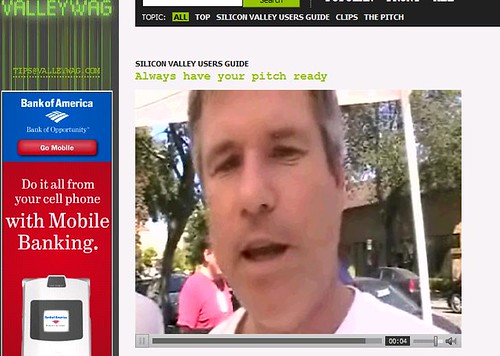
When I was picking up my badge at the registration table at BarCampBlock on Saturday afternoon, free beer in hand, I ran into Terry Chay, the “ultimate social bee,” who flits around Web 2.0 events, tirelessly cross-pollinating, until everyone knows everyone. He immediately introduced me to Sarah Meyers, of Gawker Media (parent of Valleywag), and, with a wink and a smile, he quickly disappeared into the throng. I was left alone with the winsome Sarah and her video recording rig.

Now, I like a video camera as much as (if not more than) the average marketer. But this was Valleywag. Would I be skewered like the guy from Powerset (which I thought was hilarious when I watched it from the comfort of my office)?

Today, I found out. Here’s the post. And below are two screengrabs. How did I do? Comment there, here, or in Plaxo Pulse (if you’re in my business network) to let me know. From the screenshot, it looks like it was really sunny (or else I need way more sleep).

McCreaValleywag1

McCreaValleywag2

It could have been worse. What didn’t make it onto the web? A piece of pretzel flying out of my mouth. (Thanks, Sarah!)

Or me yelling, “Captain Morgan isn’t your friend!” (He really isn’t, after all.)

Social Graph Debate: Where’s Facebook?

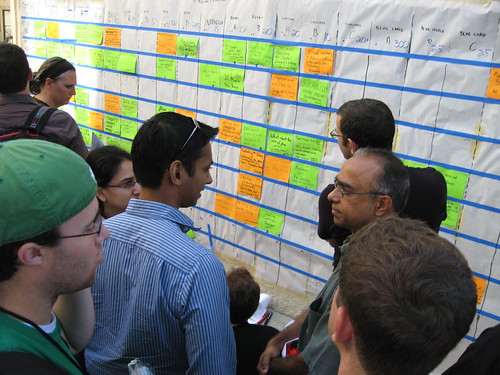
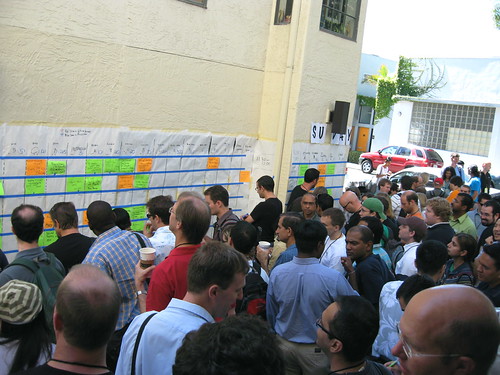
BarCampBlock was packed yesterday, with close to 1,000 in attendance. The session on Opening the Social Graph was packed, as expected. Brad Fitzpatrick (who is heading to Google), David Recordon (who is heading to SixApart), Joseph Smarr (Plaxo’s Chief Platform Architect), and Tantek Celik (until recently at Technorati) did a great job laying out the case for a new approach to assembling the social graph by traversing the linkages between various services. I assert that this is my blog, and on this blog, I assert that I am “johnmccrea” on Twitter, and so on. Using such information, a decent portion of the social graph (the public portion), can be stitched together by one or more entities, and then surfaced via APIs to a variety of social web apps. At one point, someone brought up Facebook. “Is anyone from Facebook here?” Silence. “Anyone?” Kinda odd, since the debate was taking place two blocks from Facebook’s headquarters.

IMG_0366

IMG_0364

IMG_0377

IMG_0368

IMG_0379

Great Debate Heads to BarCampBlock

BarCamp, social graph

After breakfast downtown, was strolling over to BarCampBlock and ran into Joseph, who was leaving the event for a few hours. He let me know that he had already hooked up with Brad Fitzpatrick and David Recordon, and that they, along with Tantek Celik, were scheduled now to do a session on opening the social graph at 3:30. I’ll be there. Should be a great discussion.

A few pictures follow…

IMG_0312

IMG_0313

barcamp

The Great Debate: Open Up the Social Graph?

It’s begun. There have been rumblings for a while, and lots of good private and semi-public discussions at various events in recent months, whether Mashup Camp, OSCON, or even last weekend’s “We Are All Actors” event in Austin. But now the debate about how to “open up the social graph” has fully emerged into the very public discourse of the blogosphere, starting with this afternoon’s provocative, detailed, and well-written piece by Brad Fitzpatrick (with collaboration and editing by David Recordon), entitled, “Thoughts on the Social Graph.”

Within hours, Plaxo’s Joseph Smarr, one of the smartest guys I’ve ever met, waded in, with this response, entitled “More on social network portability.”

So far, there’s more agreement than contention, with Brad, David, and Joseph all in harmony, as voices calling for an open “social graph,” as opposed to the “walled garden” approach currently championed by Facebook (and by many others in the past, such as AOL, Compuserve, and Prodigy). In the walled garden approach, a corporation asserts ownership of user-generated content, and imposes terms of use that restrict free movement of the data outside the wall. Such strategies often work well for a time, with popular closed networks generating their own economies and their own ecosystems of developers. Some of us, perhaps naively, thought this was a debate that was settled a long time ago (the mid- to late-’90’s), when the web emerged and up-ended the existing walled gardens.

That said, there are some areas of difference between Brad’s proposal and Joseph’s response, primarily around whether there should emerge some non-governmental, non-corporate, non-profit, benificent intermediary that acts as custodian of the social graph, or whether each user should be the owner of their own part of the social graph, their collection of friends lists at various sites.

My own view, not surprisingly (since I work with Joseph at Plaxo), is that the user must be the ultimate authority. Users should demand ownership, control, and portability of their data and their content, including their friends lists — and force the various providers of social web applications to interoperate in a manner that still keeps private what they do not want floating in the commons.

What do you think?