It’s once again time for making predictions for the coming year. Here I go (with thanks to all who contributed thoughts on key trends in recent weeks via Facebook, Twitter, Google Plus, and face-to-face)…
Expect four big waves to smash together in 2012 to create a single megatrend that will rock the consumer tech sector for years to come. The familiar waves of Cloud, Mobile, and Social will fuse with a new, but rapidly emerging wave of Connected Devices to unleash a virtual sky-full of “Pervasive Personal Clouds.” These clouds will enable the delivery of radically smarter, more adaptive consumer services that will delight you in unexpected ways by knowing way more about you: who you are, where you are, your history of usage, your tastes, who your friends are, what they like, and more.
Privacy may not be dead (yet), but you will find yourself increasingly happy to hand over your personal information in exchange for better service, more control, or both. And if you’re a service provider, you need to think about how you can tap these new capabilities to meet a competitive bar of personalization that will be rising rapidly.

Before bringing it all together, let’s first look at each of the four component waves:
Cloud. What’s exciting about cloud computing in the consumer landscape is its duality: not just all of your data and content “up there,” safe, secure, and accessible to you anywhere/anytime; but also an ever-growing mountain of data about you and your usage of any given service. Together these lay the foundation for “Personalization 2.0,” a complete rethinking of what service means.
Mobile. Smartphones move the liberating power of your personal computer off of your desk and into your hands, and that is a game-changer. But there’s more to come, as your smartphone becomes your all-in-one, always-with-you device, gaining capabilities well beyond that of a PC. Already, this location-aware, networked-computer-in-your-pocket has taken on the functionality of phone, web browser, Walkman, game system, camera, camcorder, television, nav system, watch, and more. More recently, it has started to become your wallet and your cash register. And in 2012, it should start become the authoritative, automated, device-based form of your identity that will unlock an amazing world of truly personalized experiences in your home — or wherever you go.
Connected Devices. Ironically, as the smartphone subsumes the capabilities of ever more standalone devices via its expanding sensor payload, Moore’s Law enables an explosion of other, smaller/embedded devices, previously not possible to manufacture. Digital, Internet-connected devices are popping up around our houses (for example, Nest, disrupting the sleepy thermostat market) and on our bodies (Fitbit, Jawbone Up, Zeo sleep monitor, etc.), able to interact with the cloud and our mobile devices. The combination of Cloud, Mobile, and Connected Devices signifies a tectonic shift to the “post-PC” era. Expect surprises in 2012 and beyond, as connected devices get small enough to fit into the buttons on your shirt or jacket.
Social. The last of the four waves (and historically the main topic of this blog) is less a technology trend and more a major cultural shift in attitudes and behavior toward sharing and privacy. It was fascinating to watch, when a few years back Facebook went from a college-only community to something accessible to adults of all ages. It could easily have gone wrong — with the adults coming in and spoiling all the fun. Instead, they adapted and embraced sharing in a way they never had before, and the party just got better. Over the years, Facebook has continued to move us all toward ever-more-open sharing — and they’re not done with us yet! Watch as “frictionless sharing” in 2012 goes from something only young folks think is normal to a mainstream behavior.
Pervasive Personal Cloud megatrend. Together, these four elements form the Pervasive Personal Cloud, a radically better way of delivering consumer services by knowing way more about you than was ever possible previously. This approach to consumer services changes the dynamics of how information is gathered (taking out all of the friction), how user experiences are personalized, how content/features/products are discovered (social vs. search), and how that discovery turns into consumption.
And these changes will play out across every major vertical and horizontal market — and invade or create a wide variety of niches. You will have your entertainment cloud (comprised of your music cloud, your video/TV cloud, your news cloud, and more), your communications cloud, and your personal productivity cloud, of course.
But you will also have your personal health cloud, which will shift the balance of power from the medical establishment to you. Your personal health cloud may include your running cloud, your sleep history cloud, you blood cloud, your genomic cloud, and, ultimately, your human biome cloud, and more. (For more info on this trend, see Larry Smarr’s 10-year quest for quantified health. And, yes, Larry’s the father of my former partner-in-crime, Joseph Smarr, and he has inspired me to get my own personal health clouds up and running. More on that in an upcoming post.) BTW, do you know how much of your typical night of sleep is comprised of the mysterious, dream-filled, learning-and-memory-enhancing REM phase? I do:
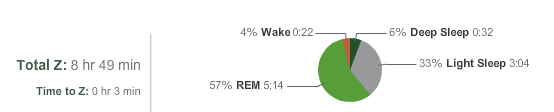
Hey, hey, you get off of my cloud! (Or not.)
But in what other ways will these Pervasive Personal Clouds impact the balance of power between vendors and consumers? Expect to see very interesting tension between two opposing forces: cloud lock-in and cloud disintermediation.
One the one side, Apple, Google, and Amazon, among others, will seek to habituate and addict you to their various cloud services. My favorite Steve Jobs quote from the recent Isaacson bio is, “I’m going to take MobileMe and make it free, and we’re going to make syncing content simple. We are building a server farm in North Carolina. We can provide all the syncing you need, and that way we can lock in the customer.” (“Maniacal laugh. Maniacal laugh.”)
The opposing force is Facebook, likely to surpass 1 billion active users in 2012, and aiming to be a new kind of middleman, helping consumers discover and connect with the various cloud services through frictionless sharing. In that model, companies like Spotify, Hulu, and Netflix can enjoy hyperviral growth in exchange for piping all of their users’ activity streams into the Facebook data vault. What happens if Facebook decides to use this data to make it easy to switch from one cloud vendor to another?
It will be fascinating to watch. Hmm, now that I think about it, maybe we should all pipe more and more of our personal cloud services through Facebook, in order to minimize vendor lock-in.
What do you think? Exciting or creepy?





 The Real McCrea