Category Archives: Uncategorized

Live Blogging from the Activity Streams Meetup

Up in San Francisco for another open spec community gathering, this one focused on working toward standardization of “activity streams,” the flow of user-generated content which is the lifeblood of the emerging Social Web. This Activity Streams Meetup is being hosted at Six Apart, with David Recordon guiding the event. As Plaxo’s Joseph Smarr tweeted, we hope this all leads to “more structured metadata in feeds”.

As usual, I’ll sprinkle in a mix of photos and observations, but not attempt to take anything approaching full notes. In addition to Six Apart, there are folks here or from Facebook, MySpace, Google, Yahoo, Plaxo, among others. That means there’s representation for projects that span DiSo, OpenSocial, Open Stack, Facebook Connect, Y!OS, MySpaceID, among others. Sweet!

Microsoft’s Dare Obasanjo has a nice post describing the problem we need to solve, entitled, Representing Rich Media and Social Network Activities in RSS/Atom Feeds. Also recommend this post from Chris Messina, Where we’re going with Activity Streams. And for more background, here’s Chris Messina’s talk on Activity Streams at the pre-holiday Open Stack Meetup:

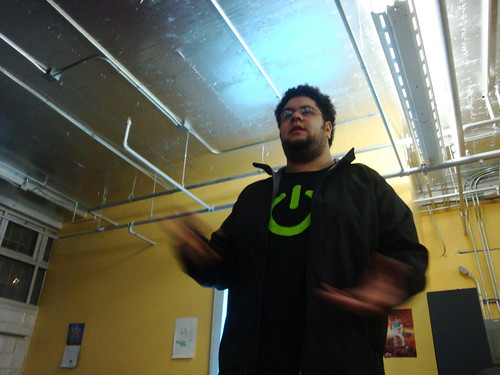
And now, some photos of the Activity Stream Meetup:

Activity Streams Meetup

Activity Streams Meetup

Activity Streams Meetup

Activity Streams Meetup

Lots of good discussion, trying to get everyone on the same page about the problem we’re trying to solve and what we can hope to accomplish today. As people are sharing all sorts of stuff from a rapidly growing list of services (examples just for photos: Flickr, Picasa, Smugmug, etc.). Every social network is either a webwide lifestream aggregator today (early examples: Plaxo Pulse and FriendFeed), or are becoming one quickly (examples: Facebook and MySpace). And every aggregator faces the same set of challenges that arise from the chaos of there being no standard for how to format the feed of user-shared content. No common convention for naming of objects or verbs. This is the classic problem space for the Open Stack of OpenID, OAuth, XRD, Portable Contacts, and OpenSocial.

Great to see the active participation from Luke Shepard from Facebook, who just shared some of the problems of complexity they experienced by having too much flexibility in the verb space. I think he just said “combinatorial explosion” to describe it.

Cool, just noticed that Ian Kennedy is live streaming the event via his mobile phone and Kyte. So now you can watch it so you don’t miss anything!

Chris Messina takes to the white board:

Activity Stream Meetup

Activity Streams Meetup

David Recordon of SixApart, who is running the Meetup, with Joseph Smarr:

Activity Streams Meetup

Okay, now we’re about to go over a draft spec… Martin Atkins of Six Apart is now going over at high-level a review of a draft spec.

Activity Streams Meetup

Activity Streams Meetup

Now, Monica Keller of MySpace is jumping in, showing an alternative proposal and getting lots of feedback.

Discussion of reviving Media RSS vs. starting with Atom Media.

David Recordon is showing a demo of a Six Apart implementation done against the current draft spec in answer to a question from Joseph Smarr about how firm the draft feels, and whether we have any good insights from early implementations. It’s a demo of an API which transforms existing Atom and RSS feeds from sites like Flickr, Twitter, Digg, and blogs into new feeds (which can also be aggregated together) that include markup from the draft Activity Streams specifications being discussed. Along with the work from MySpace, this constitutes one of the first two implementations of the draft specification.

What a great working session! We’re two-and-a-half hours in an still going strong. Good discussion now about the importance (and complexities) of handing “friending” events, whether those are bi-directional or “follows”. Some differing thoughts here from the DiSo folks vs. the big social networks. Good sharing of insights from Facebook and Plaxo.

Activity Streams Meetup

It’s after 6:00, and we’re wrapping up. Great session. Great participation from sites large and small and from folks just looking out for the open Social Web at large.

UPDATE: Check out Marshall Kirkpatrick’s excellent piece on the event on ReadWriteWeb (which also was syndicated to the New York Times) and Marc Canter’s thoughtful post, DiSo Activity Stream Standard.

Tagged , , , , , , ,

Optimism for 2009: Joseph Smarr Demos the Near-Future of the Social Web on the Open Stack

Joseph Smarr at the Open Stack Meetup

It is kind of fashionable at the moment to point out the real or imagined shortcomings of OpenID, in light of the elegance of Facebook Connect. But the reality is that together with the other elements of the Open Stack (OAuth, XRD, Portable Contacts, and OpenSocial), OpenID is entering 2009 with incredible momentum, and tantalizing possibilities. And no one is more capable of demonstrating the possibilities than Plaxo’s Joseph Smarr, who “kicked ass” at the recent Open Stack meetup. Video of his killer presentation with demos has just been posted online. Yes, it’s geeky, and the demos are not pretty to look at, but the new capabilities shown will be turned into product early in 2009 at Plaxo, Google, Yahoo, and MySpace, among others. If you want a glimpse into the near-future of the Social Web, built on the Open Stack, this is 17 minutes of must-see TV:

Also, check out Joseph’s new post reviewing six months of progress on Portable Contacts.

Tagged , , , , , , , ,

My Keynote Address at Last Week’s Open Stack Meetup

2008 is going out on a high note, with incredible momentum for the new Open Stack. I had the honor of delivering a brief introduction to the Open Stack at last Friday evening’s Open Stack Meetup in San Francisco. We’ll end up using this material on The Social Web TV somehow, but thought I’d share this you now. [Warning: Contains cursing.]

Tagged , , , , , ,

Happy Holidays from The Social Web TV

This episode went up over the weekend over at The Social Web TV. After many weeks of travel, Chris Messina is back, joining me and Joseph Smarr for our first year-end holiday show. You can see me develop off the top of my head some of my bold predictions for 2009.

Tagged ,

For Posterity: The First-Ever “Open Stack” Meetup

I’m just back from a great evening in San Francisco for the first ever Open Stack Meetup, put together by David Recordon of SixApart and Joe Stump of Digg, and hosted at Digg. I had the honor of kicking off this historic event with a keynote on the Open Stack, as a whole greater than the sum of its parts. [Update: Video of my keynote is now online.]

The godfather of open, Marc Canter reports that there were about 100 people there, and I totally agree with him that “Joseph Smarr just kicked ass”. There was a mix of vision, description, and demo, and it all came off pretty well (given how little coordinated planning was involved). Plus, we gave out a cool new t-shirt that said, “I hack on the Open Stack”.

Here are a few photos I took. We’ll follow it up with video on The Social Web TV.

Eran Hammer at the Open Stack Meetup

David Recordon at the Open Stack Meetup

David Recordon at the Open Stack Meetup

Allen Tom at the Open Stack Meetup

Kevin Marks at the Open Stack Meetup

Kevin Marks at the Open Stack Meetup

Joseph Smarr at Open Stack Meetup

Joseph Smarr at Open Stack Meetup

Joseph Smarr at Open Stack Meetup

Joseph Smarr at Open Stack Meetup

Joseph Smarr at Open Stack Meetup

Joseph Smarr at Open Stack Meetup

Chris Messina at Open Stack Meetup

Tagged , , , , , , , , , , ,

As Online Identity War Breaks Out, JanRain Becomes “Switzerland”

Weezer One

Last week’s simultaneous launches of Facebook Connect and Google Friend Connect diverted attention from an equally important launch: A major rollout of a universal login service, called RPX, from a Portland, Oregon-based startup, JanRain. The company announced that RPX is being rolled out to over 200 properties operated by Universal Music’s Interscope Geffen A&M, bringing simplified login to music group sites like Weezer, Lady Gaga, and Snoop Dogg, among many others.

Until now, JanRain has been a pureplay OpenID solution provider, hoping to build a business just on OpenID, the promising open standard for single sign-on. But the company has now added Facebook as a proprietary login choice amidst the various OpenID options on RPX, a move that shifts them into a more neutral stance, straddling the Facebook and β€œOpen Stack” camps. In my view, that puts JanRain in the interesting and enviable position of being the “Switzerland” of the emerging online identity wars.

Weezer Two

For site operators, RPX offers an economical way to integrate the non-core function of “login via third-party identity providers” at a time when the choices in that space are growing and evolving rapidly. So, rather than direct its own technical resources to integrating Facebook Connect and the various OpenID implementations from MySpace, Google, Yahoo, AOL, Microsoft, along with plain vanilla OpenID, a site operator can simply outsource all of those headaches to JanRain. A free version is available for small sites; large sites will typically choose the Pro version that starts at $1,000 per year and scales with the number of registered users. Having seen what it takes right now to integrate with all the latest identity offerings from my work with Joseph Smarr at Plaxo, I can imagine lots of sites finding RPX a very attractive alternative.

Lee Hammond, an executive of Interscope Geffen A&M sums it up nicely:

β€œIt’s a double win, really. Through RPX we’re presenting the broadest range of sign-in options for users without having to chew up internal development resources to keep them current. I’m looking forward to when Microsoft rolls out OpenID because it will just ‘show-up’ without requiring additional time from our developers to support it.”

JanRain effectively becomes a middleman between destination sites and the online identity providers, offering a single, tightly integrated service that normalizes the widely varying solutions. In the process the company finds itself an aggregator of highly valuable data on market adoption trends across a large and growing number of sites and across all the identity providers.

One key question all this raises: Given a menu that includes AOL, Facebook, Google, MySpace, Yahoo, and OpenID, which brand will users choose as their preferred way to sign in to new sites? The RPX service hasn’t been out long enough to know that answer in any sort of definitive way. But, early results make it clear that the answer will differ from site to site, depending upon audience demographics. While RPX’s current user interface offers the same choices for all sites, the plan is to introduce the flexibility to tailor the options to the specific site, based on usage data. So, if your site is wildly popular with the MySpace crowd and very few people choose to login with, say, their AOL OpenID, you might choose to simplify the UI by removing the AOL-branded option. (Motivated AOL users could still pick the OpenID-branded choice and log in that way.)

For those who have wondered whether OpenID and the Open Stack could end up with a user interface and user experience to match Facebook Connect, it’s clear that RPX is a big step forward, with a clean “lightbox” UI. And for those who have wondered what sites will do when confronted with the choice of Facebook Connect or OpenID, RPX helps to remind us that sites want maximum audience and are keen on presenting whatever choices get them the most users and the best new-user onboarding. I got to see some of the data from the first few days of RPX on Universal Music sites, and the thing that struck me was that none of the identity providers accounted for a majority of logins, but that the OpenID providers in aggregate did, at just under 60%. It’s going to be really interesting to watch how all this shakes out. I look forward to seeing the data after a few weeks have passed.

For more coverage of this important story, see last week’s piece by Rick Turoczy of ReadWriteWeb.

The Social Web: My Predictions for 2009

Gypsy_fortune_teller

It’s that time of year, when would-be futurists are compelled to publicly assert their predictions for the coming year. IMHO, I knocked it out of the park with my prediction for 2008.

So, I decided to go bigger this year, and make not one, but five bold predictions around the emergence of the Social Web.

Prediction 1: Facebook will begin its migration to the “Open Stack” and roll out support for at least one piece of it. Leading candidates: OpenID and OAuth.

Prediction 2: Google, Yahoo, and Microsoft will rollout support for Portable Contacts for their respective webmail services.

Prediction 3: Microsoft will implement OAuth, at least for Portable Contacts, if not more broadly.

Prediction 4: Microsoft’s “Windows Live” social network will become an OpenSocial container.

Prediction 5: Plaxo will so successfully prove onboard turbocharging via the Open Stack that they will abandon traditional email/password signups entirely.

These predictions are solely my opinion and are not based on any knowledge of specific product plans — except for maybe number 5. πŸ˜‰

As with last year, I will check in on these at mid-year and end of the year.

Tagged , , , , , , , ,

It’s Time to Vote for the OpenID Board

The OpenID Foundation is having its first-ever election of “community board members”. Seven seats are up for grabs, and there is an impressive slate of 17 candidates in the running. Voting closes on December 24, so if you want the Open Stack to win in 2009, you might consider joining the OpenID Foundation (cost $25) so that you can help determine its governance by casting your vote.

Readers of my blog and viewers of The Social Web TV will see several familiar names, but I think I will refrain from endorsing any specific candidates. You can probably guess some of my votes. πŸ˜‰

It’s great to see Luke Shepard of Facebook in the running, which stokes hopes that we will one day see Facebook implement some or all of the Open Stack.

Foundation members can cast up to seven votes. I confess I found it very difficult, because there are so many really qualified candidates. That bodes well for this important open standard.

Tagged

8 Minute Abs? Try 8 Minute Facebook Connect!

When I wrote about the launch of Facebook Connect and Google Friend Connect last week, I tried to explain the similarities and the differences. One difference I suggested was ease of implementation. I knew that Google Friend Connect was really easy, that they had focused on “cut-and-paste a few lines of javascript”. But here’s what I said about Facebook Connect:

A second difference is target market. Facebook has clearly focused on major sites, like Digg, Hulu, and CitySearch, and while simple implementations can be done with very little coding, most will involve a bit more complex development.

Last evening, I learned otherwise, watching a video whose title says it all, “Add Facebook Connect to Your Blog in 8 Minutes“. Engineers from the Facebook Connect team, Luke Shepard and Wei Zhu, take you through the process with a great, straight-forward guide to implementing Facebook Connect. I’m not a developer, but I found the presentation really straight-forward. Great job, Luke and Wei! (Hey, Luke, you are welcome as a guest on The Social Web TV any time.)

8 Minute Facebook Connect

(I would have embedded the video here, but hosted WordPress has severe limitations around what can or cannot be embedded. Lame.)

So, it really will be interesting to watch adoption of Facebook Connect and Google Friend Connect in the “long tail” of the Web. I wonder if we’ll start to see directories that can let us know all the sites that implement either. Would be fun to check them out and to compare and contrast.

Anyway, I stand corrected. Congrats to the Facebook Connect team on a great rollout. I note that CNET is live today with their integration.

Tagged , ,

Birth of the Social Web: Facebook Connect and Google Friend Connect Now Available to All

December 4, 2008. Today may be remembered as the birth of the Social Web, as two major projects aimed at turning the Web social emerged from their restricted beta periods for general availability, Facebook Connect and Google Friend Connect. Together, these two major events sound the death knell for the walled garden phase of social networking. Early reactions to the news are quick to frame this as a head-to-head battle between Google and Facebook, but the truth requires a look at the details, and I think something much more profound is happening…

First, the similarities. Facebook Connect and Google Friend Connect share the same basic vision of the Social Web. Any site can become social, without having to build up its own social network. Users should be able to access those social features without having to experience the pain of usernames, passwords, uploading a photo, filling out a profile, importing an address book, and re-friending the people they’ve already connected with elsewhere. And, activity streams out to web-wide lifestream aggregators should become important engines of social discovery and growth for the site.

Now to the differences. One major difference between these two offerings is the technology under the hood. Google Friend Connect is built on the “open stack,” leveraging building blocks like OpenID, OAuth, and OpenSocial, whereas Facebook Connect is built on Facebook’s proprietary stack. A second difference is target market. Facebook has clearly focused on major sites, like Digg, Hulu, and CitySearch, and while simple implementations can be done with very little coding, most will involve a bit more complex development. Google, in contrast, has explicitly targeted the “long tail” of the web, sites that would never dream of writing their own social code; the focus of Google Friend Connect is to help these sites become social by cutting-and-pasting a few lines of javascript. The third major difference is one of strategy. Facebook Connect is all about making Facebook more useful to its users all over the Web. Google Friend Connect, on the other hand, is all about making the Web more social, with an approach that incorporates other social networks. For example, the current release integrates not only Orkut, but also Plaxo. (And recall that the earliest version also included Facebook, until Facebook shut that down.)

I’ve been playing around with Facebook Connect and Google Friend Connect all along the way while these services were being carefully tested and refined prior to today’s formal rollout. I like them both, but see lots of room for improvement. But that’s to be expected; this is a major shift in how the Web will work, and there’s a lot of complexity under the covers. Today marks the birth of the Social Web, and we should expect to see lots of rapid progress for this newborn.

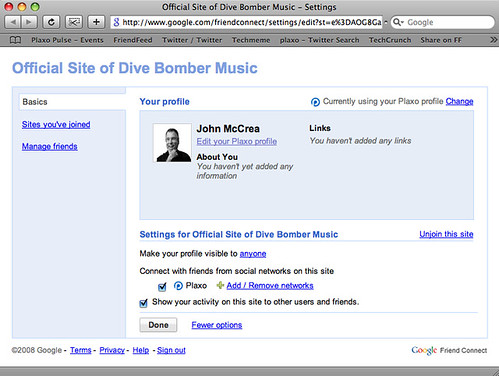
For those who haven’t checked out Google Friend Connect yet, I’m including a few screenshots…

Signing up via Google Friend Connect

Turning on Sharing to Plaxo

Signed in with a single click

Activity shows up in Plaxo!
My activity showing up in Plaxo

Oh, and you can check out the “Dive Bomber” site I used for these screenshots here.

Update: I just realized that I can now declare victory on the prediction I made for 2008, a prediction I made on December 6, 2007!

Update: The new episode of The Social Web TV is now up, with Joseph Smarr and I addressing the question, “Facebook Connect vs. OpenID?”:

Tagged , , , , ,