Thanks, SGI, for the Gift of OpenGL!

I am so pleased to see SGI in a good news story today, after all the years of decline and sadness. Apparently there’s been a problem brewing with the license under which SGI was making OpenGL available, as in it was a license that was “accepted by neither the Free Software Foundation (FSF) nor the Open Source Initiative,” according to Bruse Byfield of Linux.com. The problem has now been resolved through a new license. Details can be found in a press release from SGI. The new license was applauded by both the Free Software Foundation (FSF) and the Khronos Group, an organization developing royalty free standards around OpenGL.

I’ve been thinking about OpenGL recently, as it helped introduce me to open standards, years ago when I worked at SGI. Back in late 1995, after I persuaded SGI to become the first licensee of Java, I tried (and failed) to convince Sun to follow SGI’s lead to make Java a truly open standard, rather than a Sun proprietary thing, with heavy licensing.

Now, as we work to solidify and gain traction for a “new open stack” for the emerging Social Web, I continue to be inspired by the bold idea behind turning SGI’s proprietary “GL” (Graphic Library) and into OpenGL.

The new open stack is comprised of OpenID, OAuth, OpenSocial, XRDS-Simple, and Portable Contacts. Projects as diverse as MySpace Data Availability, Y!OS, Google Friend Connect, and Plaxo Pulse now share a common vision (of an open interoperable Social Web) and are being built out on this common set of open spec building blocks. Each company can innovate faster by not having to waste development resources on creating one-off proprietary APIs. Each company can see more rapid uptake by developers, since those developers can write once and have there code work in more places. And each company can be part of the virtuous cycle of acceleration by contributing code to the open stack.

Exciting times!

The New "Open Stack" for the Social Web

Tagged , , , , , , , , , , ,

Yahoo’s “Y!OS”: Strong Proof the Web is Going Social — and Open!

Some really big news came and went last week, with relatively little attention paid to it by the mainstream media. Yahoo, the top Internet site in a major battle to regain it’s “mojo,” unveiled the details of “Y!OS” (Yahoo Open Strategy), a truly bold move that completely re-defines the notion of a portal. [See also nice coverage on Mashable by Rob Diana.]

Just as the “open” wave is transforming social network from walled gardens into aggregation hubs for connecting with the rest of the Web, Y!OS will transform Yahoo from a traditional portal into something entirely new. They’re doing it all by building on top of open spec building blocks, including OpenID, OAuth, and OpenSocial. And they’re not just taking these blocks off the shelf; they’re also giving back, contributing their own innovations in the spirit of let’s-all-work-together to keep the web open.

To learn more about Y!OS, we invited Cody Simms, Sr. Director of Product Management from Yahoo on to our weekly Internet TV show, The Social Web TV. Cody is a really dynamic guy; I think you’ll agree this is a great episode!

Tagged , , , , , , ,

Plaxo Becomes “Portable Contacts” Provider, Helping Vet the Draft Spec

Portable Contacts deep dive

As a follow-on to last week’s Portable Contacts Summit, Plaxo has updated its API site, de-emphasizing the company’s proprietary APIs in favor of Portable Contacts and the other associated “open stack” building blocks (OpenID, OAuth, microformats, OpenSocial, etc.). While the spec still remains in a draft state, the community agreed that it is time to start getting multiple live implementations up, as part of the process of vetting the current (and any future) draft. Only in that way can there be a fully-informed decision process to declare a final 1.0.

Joseph Smarr, who is Plaxo’s Chief Platform Architect and the de facto leader of the grass roots Portable Contacts initiative, blogged about the update to the API site in a piece entitled “Portable Contacts is Now Plaxo’s Primary API“:

We’ve revamped Plaxo’s developer section to focus primarily on the open building blocks we’re using. Starting now, developers should consider OAuth and Portable Contacts the primary way to access profile, address book, and pulse connections data from Plaxo. The idea is simple: once you write code to work with Plaxo, you can use that exact same code on a variety of other sites. And if you’ve already integrated with one of those sites, you can start working with Plaxo right away. After all, one of the main drivers to create Portable Contacts was the pain developers face having to write custom, one-off API implementations against every site they deal with. So we think it’s time to start living the good life, where common specs mean less writing code and more interoperability with more sites.

Given the strong support demonstrated at the Summit, we expect to see other implementations in the wild soon. And since Portable Contacts is all about enabling interoperability between Social Web services, it is critically important that we test a variety of cross-site scenarios live before declaring this or a future draft to be “1.0”.

One really cool thing is that all of the companies that fully implement the new OpenSocial RESTful APIs will be Portable Contacts compliant “out of the box” — without having to write any additional code. That’s because the Portable Contacts community worked with the OpenSocial community to technically align the two specs. So, don’t be surprised to see Portable Contacts support coming soon to some really big Internet players. (Hint: Google and MySpace had live demos at last week’s Summit.)

I am starting to feel very confident in my prediction for 2008! 🙂

If you are a developer who wants to jump in and get started on Portable Contacts, head over to Plaxo’s just-updated API site.

Update: I just also got a link to a live Portable Contacts demo from JanRain, which ties together OpenID and Plaxo’s implementation of Portable Contacts. Very cool.

[Reminder/disclosure: I work for Plaxo.]

Tagged , , , , ,

Live Blogging from the Portable Contacts Summit

The much-anticipated Portable Contacts Summit has kicked off, with folks from companies large and small and representatives of various open-spec communities. Joseph Smarr of Plaxo is leading the opening session and is going through a bunch of demos of working code.

Some quotes:

“The Portable Contacts train has left the station, and it’s a bullet train.”

“I’ve got more demos than I have Firefox tabs.”

“One good pipe deserves another.”

Joseph is demoing the power of having technical alignment between Portable Contacts and OpenSocial RESTFul APIs. What that means is that any site that is OpenSocial compliant will be Portable Contacts compliant — without having to do any additional work!

Folks in attendance include people who work at Google, Microsoft, Yahoo!, MySpace, Facebook, Hi5, Plaxo, Six Apart, Seesmic, JanRain, Skydeck, ShopIt, Current.TV, Interscope Records, and more. Today’s event is hosted by MySpace.

12:00 Joseph demoing interop between Plaxo and MySpace.
12:05 Now a demo of JanRain’s myOpenID with support for Portable Contacts
12:07 Now on to Google, another instance of compliance via OpenSocial RESTful APIs
12:08 iGoogle, GMail, and Orkut (all leveraging the same backend)
12:09 Brian Ellin of JanRain about to do a demo of an end-user application
12:11 Brain implemented Portable Contacts last night in Ruby

lunch break

1:00 About to resume. Saw amazing discussions over lunch. I won’t name names, but some would be shocked by the various pairings of competitors breaking bread together
1:15 Joseph leading a deep dive on the spec. Lots of questions, discussion.
1:30 Lots of great questions and discussion about OAuth and XRDS-Simple
3:00 Wow! Just barely made it all the way through the spec. Impressive. Everyone is fried.
3:30 Unconference phase now, but really informal; organically forming conversation circles.
4:15 About to do the next steps and wrap up

Kevin Marks, of Google, is doing a nice job live tweeting the event. He’s @kevinmarks on Twitter.

UPDATE:

Great posts from the team at ShopIt and from data portability maven Daniela Barbosa.

And another fine post from the godfather of open, Marc Canter.

Here are a few photos so far:

Spec-compliant name tag

Joseph Smarr kicks off the Summit

Around the room

Brian from JanRain

Brian of JanRain and Joseph of Plaxo

Portable Contacts deep dive

Tagged , , , , , , ,

Live from the PortableContacts Hackathon

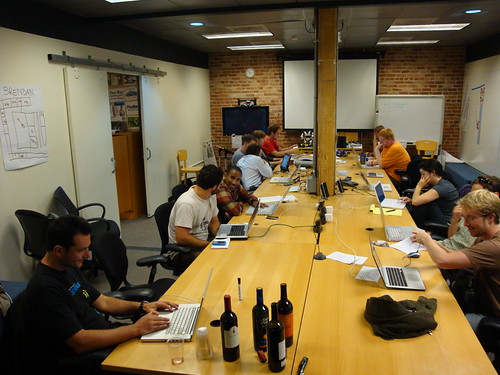
Inspired by the great energy at the PortableContacts Hackathon. About 15 folks, passionate about fleshing out the open-spec building blocks and putting them into action. I think they’ll be some great demos tomorrow at the PortableContacts Summit!

Thanks to David Recordon and Six Apart for hosting and to Joseph Smarr of Plaxo for leading the event.

From the PortableContacts Hackathon

From the PortableContacts Hackathon

From the PortableContacts Hackathon

From the PortableContacts Hackathon

PortableContacts Portable Keg

PortableContacts Hackathon

Kevin Marks, Patrick Chanezon, Joseph Smarr

PortableContacts Hackathon

PortableContacts Hackathon

PortableContacts Hackathon

PortableContacts Hackathon

DSC00514

David has a nice writeup on the Hackathon at O’Reilly Radar.

Tagged , , , ,

A Big Bang for the Social Web

It’s certainly a big week, what with the Hadron Collider finally coming on line, raising existential risk questions for the planet, as physicists attempt to recreate the conditions immediately after the Big Bang that gave birth to our universe. Meanwhile, in San Francisco, developers are attempting to give birth to a truly open Social Web, by stitching together for the first time the open spec building blocks: OpenID, XRDS-Simple, OAuth, and PortableContacts.

You can participate yourself at the PortableContacts Hackathon this evening, hosted by SixApart. Or you can get the quick overview in this video podcast I did with Plaxo’s Joseph Smarr.

Tagged , , , , , , , ,

Pure-Play Aggregators: A Traffic Update

Compete released the stats for August, with mixed news for the pure-play Social Web Aggregators. Plaxo continued to see nice growth, clocking 244% year-over-year growth and 11% month-over month growth in monthly unique visitors. FriendFeed, on the other hand, experienced a bit of a stall, with a tiny drop in monthly unique visitors compared with July. SocialThing (recently acquired by AOL) got a traffic increase from the news of its acquisition, but total monthly unique visitors remains under 100,000. Iminta’s traffic was too low to track.

Picture 8

Can the pure-play Social Web Aggregators grow fast and long enough to achieve escape velocity before the big former walled garden services, like Facebook and MySpace, re-invent themselves into true Social Web Aggregators?

Tagged , , ,

Happy First Birthday, Bill of Rights for Users of the Social Web!

A mere 12 months ago, the word “open” was being abused to describe proprietary walled garden platforms. There was no “open social” movement. There was no popular outcry for “data portability.” And the big social networks had no plans to let their users take their own data and content with them to other services.

And then, on September 4, 2007, an important document was published to the Web, co-authored by Joseph Smarr of Plaxo, Marc Canter of Broadband Mechanics, and two prominent bloggers, Michael Arrington and Robert Scoble. It was the Bill of Rights for Users of the Social Web, and it laid the foundation for the amazing transformation now under way and accelerating.

We publicly assert that all users of the social web are entitled to certain fundamental rights, specifically:

Ownership of their own personal information, including:
their own profile data
the list of people they are connected to
the activity stream of content they create;
Control of whether and how such personal information is shared with others; and
Freedom to grant persistent access to their personal information to trusted external sites.

To celebrate the first birthday of this influential document, we invited Marc Canter on to our weekly Internet TV show, The Social Web TV. Marc “brought the thunder” (to borrow a phrase from Gary Vaynerchuk). Check it out:

Live from Facebook Developer Garage in Palo Alto

DSC00342

The venerable old Blue Chalk is bursting at the seams with a swelling crowd of developers who have gathered for the Facebook Developer Garage event focused on Facebook Connect. I’m here with Joseph Smarr, also of Plaxo, and hanging out with David Recordon and with Dave Morin and our many Facebook friends. I also have with me tshirts that say, “Plaxo and Facebook are now in an open relationship”. If you ask me for one at the event, I’ll give it to you!

This is a follow-up event to the recent F8, where Connect debuted. Here’s our coverage from F8:

I’ll add to this post as the event rolls.

Josh Elman is opening up the event, saying it’s gonna be a talk from Dave Morin talking first, followed by demos, including David Recordon for SixApart, followed by CBS and RedBull, and then a WordPress plug-in developed internally at Facebook. And here comes Dave…

DSC00346

DSC00352

Dave sharing a vision of the Social Web built on three key elements: identity, friends, and feeds. As readers of this site know, I couldn’t agree more! Check out our Social Web ecosystem charts in this post, which we developed for Joseph Smarr’s talk at Web 2.0 this year.

Me in the t-shirt:

DSC00359

A really cool shot of Mike Vernal, “bathing in the code”:

DSC00364

Tagged , ,

My Platform Switch: Hello, iPhone, MacBook Air, Sony Cybershot, Comcast Triple Play!

It’s a season of platform change in my personal life, an exciting time of new devices and services. I’ve just ditched my old-fashioned Treo device + crappy Palm software (and no-complaints Sprint service) in favor of the the 3G iPhone (which happens to come with AT&T). I’ve junked my heavy, clunky Windows laptop from Lenovo that took forever to boot up or shut down, in favor of the slim, no-hard-drive MacBook Air from Apple. I’ve abandoned the sluggish, blurry, Canon Powershot pocket digital camera in favor of a snappy new Sony Cybershot with a 28mm (wide-angle) lens and some great image stabilization technology.

And on the “digital home” front, I’ve transitioned from getting my television via satellite (DirectTV), and my broadband vis DSL (SBC), and my phone from the phone company to getting it all together from my new employer, Comcast. [No, I am not shilling here. The main driver for this transition was that I get the triple play as an employee benefit. That said, to borrow a slogan from McDonald’s, “I’m lovin’ it!”]

Why is all this important? I think we are living in some very exciting times (again), now having fully recovered from the post-dot-com-bubble slump in the first half of the decade. I think we are in the early phase of a *major* wave of change. This will be a golden era for developers and consumers, driven by Moore’s Law, open standards, great design, and Darwinian competition. And I plan to photograph, video, and blog it with all these great devices and services!

Tagged , ,